
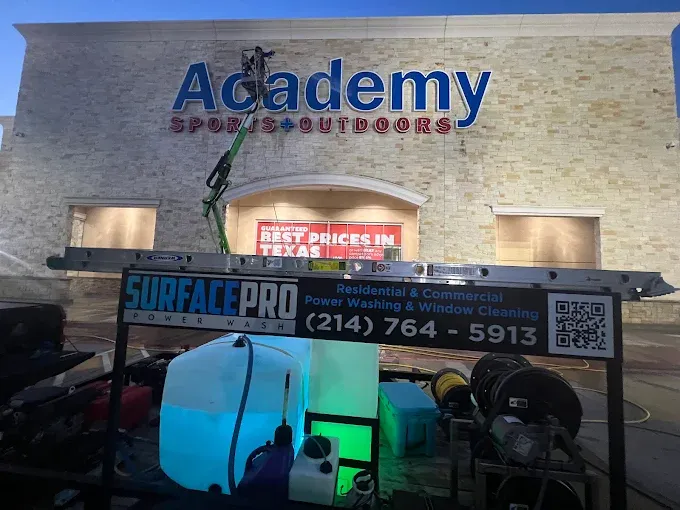
What a building exterior collects
Surface Pro Power Wash is an exterior cleaning company based in Plano, TX, and facade cleaning is the most visible commercial work it does. A building face is judged from the parking lot before anyone reads a sign. In the Dallas-Fort Worth climate, exteriors pick up algae and mildew on shaded and north-facing elevations, a gray film of road grime and exhaust on anything facing a busy corridor, spring pollen that settles into every texture, rust bleeding from anchors and railings, and the dark streaking that runs down a wall below every ledge and gutter. None of it happens evenly, which is why a building often looks worse on one elevation than the rest and why cleaning is planned elevation by elevation rather than as one job.
Reaching the whole facade
A facade cleaning promise means nothing without an honest answer about access. Ground-level and lower elevations are cleaned from the ground, including with water-fed extension poles that carry solution and rinse well above head height without putting anyone on a ladder. Higher elevations are reached with lift equipment matched to the building and the site, which is why the assessment step covers more than materials: it confirms building height, what is in the way, whether the ground will take a lift, and where it can be positioned and moved.
That planning is what separates a facade quote that holds from one that changes on the day. Overhead power, landscaping, drive lanes that cannot be blocked during business hours, and rooftop equipment above the work all get identified before a schedule is set.
The material decides the method
A commercial facade is rarely one material. A single elevation often carries masonry, a metal band, painted steel, and a glass storefront, each of which fails differently under the wrong approach.
Brick, block, and masonry
Mortar joints are softer than the units around them, so pressure erodes the joints first and opens a path for water into the wall. Masonry is cleaned with a low-pressure chemical application and a wide rinse. On older or softer brick the risk is spalling, where the harder fired face pops and the softer core underneath begins to crumble, so pressure is kept well below the point where the face is at risk.
EIFS and stucco
EIFS, short for Exterior Insulation and Finish System, is a thin acrylic finish over mesh and foam board, and the finished layer is only millimeters thick. It can be punctured outright by a pressure washer, and water driven behind it is the most common way an EIFS wall fails. Traditional stucco is more rigid but carries hairline cracks that pressure opens. Both are soft washed at low pressure and kept wet through the full dwell so the solution keeps working rather than drying on the wall.
Metal wall panel
Architectural metal panels carry a factory-applied finish that is the whole point of the panel. Harsh chemistry and aggressive pressure dull it, streak it, or strip it unevenly, and the result is more conspicuous than the dirt that prompted the call. Panels are cleaned with mild detergent at low pressure and rinsed thoroughly, working top down so runoff never dries on cleaned panels below.
Tilt-wall and precast concrete
Common on offices, industrial buildings, and big-box retail, tilt-wall panels are usually painted or coated, so the coating rather than the concrete sets the limit. Panel joints and sealant lines matter here: pressure aimed directly into a joint damages the sealant that keeps the wall watertight, so joints are rinsed across rather than driven into.
Storefront glass and glazing surrounds
Frames, gaskets, and perimeter sealant around storefront glass are cleaned rather than blasted, because high pressure at a glazing edge can breach the seal. Facade washing leaves glass rinsed as part of the elevation. Detail window cleaning to a finished, streak-free result is a separate scope, and which one a property wants is settled in the quote.
Not every stain is dirt
Several problems on a commercial facade look similar from the parking lot and are treated in opposite ways, so identifying them comes before spraying anything.
Organic growth, the green film and black speckling on shaded and north-facing elevations, responds to the cleaning solution and is the most common facade complaint in the DFW climate.
Pollution and traffic film, the flat gray cast on elevations facing a busy road, is carbon and road grime that needs detergent and dwell time rather than more pressure.
Rust staining below anchors, railings, downspouts, and irrigation overspray is mineral and ignores a normal wash solution entirely. It is treated with a specialty rust remover, and because it comes from a corroding source above, it returns unless that source is dealt with.
Efflorescence, the white powdery bloom on masonry, is mineral salt left behind as water moves through the wall and evaporates at the face. Nothing is alive in it, so no amount of cleaning solution removes it, and its presence points to a moisture path worth investigating rather than just washing away.
Hard-water spotting on lower walls usually traces back to sprinkler overspray hitting the same section of the building every morning.
Spray-paint vandalism is its own scope with its own chemistry, handled through graffiti removal rather than facade washing.
Working around an occupied building
Most commercial buildings cannot pause for a wash. Facade work is sequenced elevation by elevation, with entrances kept open and protected and pedestrian routes managed as the work moves. Retail and office properties are commonly cleaned early, after hours, or on weekends.
The assessment identifies what has to be protected before any water moves: HVAC and fresh-air intakes, exterior electrical and signage lighting, security cameras and card readers, landscaping and beds below the work, and the sidewalk and drainage where runoff will end up. Tenants are far more tolerant of the disruption when they know the schedule in advance, so the plan goes to the property before the crew arrives.
Built for how facility managers buy
Facade cleaning is usually bought by someone reporting to an owner or a corporate real estate team, so the work has to come with more than a clean wall. Scope is written against the assessment, elevation by elevation, so everyone knows what is included and what is not. Before and after photos per elevation let a manager confirm the result without standing in the parking lot. Recurring frequency can be set per elevation rather than for the whole building, since a shaded north wall and a covered entry rarely need the same interval. Surface Pro Power Wash is fully insured, and the documentation a property management company needs for vendor onboarding is provided when the account is set up. For portfolios, buildings are scheduled together rather than negotiated one at a time.
More than 20 national brands, including Walmart, ExxonMobil, 7-Eleven, and Academy Sports, rely on Surface Pro Power Wash, and the company was named Best Exterior Cleaning Company in Dallas-Fort Worth at the 2026 Facilities Management Awards by BUILD Magazine.
Building exterior cleaning across Plano and DFW
Surface Pro Power Wash cleans building exteriors in Plano and across the wider Dallas-Fort Worth metro, including Frisco, McKinney, Allen, Richardson, and Dallas. The lot and walkways below the building are handled with parking lot pressure washing, structured parking with parking garage cleaning, apartment communities with multifamily and apartment cleaning, and new construction handover with post-construction cleaning. To get started, request a free quote.