
What builds up on DFW concrete
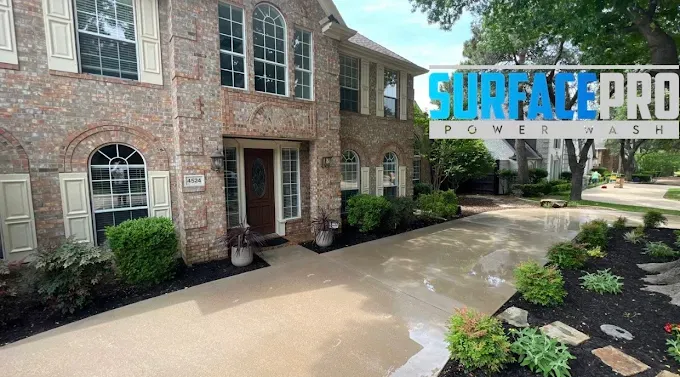
Concrete is porous, and everything that lands on a Dallas-Fort Worth driveway settles into it. Shaded slabs grow algae and mildew through the warm, humid spring. Live oaks drop leaves and acorns that leave brown tannin stains every fall. Sprinkler systems running on iron-rich water paint orange rust arcs across the edges, cars leave tire marks and oil drips, and the whole surface slowly darkens to gray. Surface Pro Power Wash is an exterior cleaning company based in Plano, TX, and driveway and concrete cleaning is the reset: the buildup comes off and the slab returns to an even, uniform color.
Chemistry first, then an even finish
Two things separate a professional flatwork cleaning from a rental-machine weekend. The first is chemistry. The concrete is pre-treated with a cleaning solution and given time to dwell, so algae, mildew, and tannin staining break down before any pressure touches the slab. Pressure alone cannot remove organic staining evenly; it just pushes it around. The second is the equipment. Surface Pro Power Wash cleans flatwork with a rotating flat-surface cleaner, which spins two nozzles at a fixed height under a shroud and produces one consistent finish across the entire slab. A handheld wand leaves the overlapping stripes contractors call zebra striping, because the angle and distance change with every swing, so the wand comes out only for edges and rinsing. Pressure stays controlled the whole time, because the top of a finished slab is a thin layer of cement paste called the cream, and a turbo nozzle held too close etches it away for good.
Broom-finish, stamped, exposed aggregate, and pavers
A driveway is not just concrete. The finish determines the method, and the wrong method damages each finish in a different way.
Broom-finish concrete, the standard poured driveway across DFW, gets its texture from bristles dragged through the thin layer of wet cement paste at the surface. That cream layer is exactly what careless pressure destroys, and etched concrete cannot be repaired without grinding or resurfacing. Broom-finish slabs are cleaned with the surface cleaner at controlled pressure after a chemical pre-treatment, then treated again where organic staining lingers, which evens out the finish across the whole slab.
Stamped concrete is really a sealer job. Its color depth and sheen come from a film-forming acrylic sealer, and that film is also what blocks stains and UV fading, so stripping it with high pressure leaves the color coat exposed and the stamped detail worn. Stamped surfaces are cleaned at low pressure with wide fan tips and mild detergents, which cleans the sealer instead of cutting through it. Texas heat is hard on these sealers, and a dull, faded look is the standard sign the film has worn through and the surface is due for resealing, typically every two to three years depending on sun, weather, and traffic.
Exposed aggregate holds its stones with nothing but the surrounding cement paste, because the finish is made by washing the surface paste away at installation to reveal the rock. Pressure held too close or run too aggressively can dislodge stones, especially on older driveways where the paste or sealer has weathered. Exposed aggregate is cleaned with moderate, even pressure and a mildly alkaline cleaner, never harsh acids, because acid attacks the very paste that grips the stones. Its sealer clouds and wears from sun and traffic on roughly the same two to three year cadence as stamped concrete.
Pavers are a system, not a slab. The sand in the joints is structural: it locks the field together, and a jet aimed into the joints blows it out, which lets pavers shift and invites weeds and ants. Paver cleaning is done at controlled pressure worked across the joints rather than into them, and joints that have already lost their sand call for re-sanding with polymeric sand once the surface is clean and dry. The white haze that shows up on pavers is usually efflorescence, a natural lime deposit that migrates out of the concrete and reacts with air to form calcium carbonate. It is harmless, it does not respond to pressure washing, and it is dissolved with a dedicated acid-side cleaner, though it can return while salts remain in the units.
Stain treatment matched to the stain
Stains are chemistry problems, and the biggest mistake in concrete cleaning is throwing one product at all of them. Oil and grease respond to an alkaline degreaser that emulsifies the petroleum so it rinses away; fresh spots usually disappear, while oil that has soaked in for years may lighten to a faint shadow. Rust does not respond to pressure or to bleach at all. The orange arcs left by sprinklers and the rings under metal furniture are iron oxide, and they are dissolved with an acid-side rust remover built on oxalic acid, which converts the iron into a salt that rinses off. Tire marks on bare concrete are plasticizer residue from the rubber and lift with a degreaser, dwell time, and agitation, while dark tire marks on a sealed driveway usually mean the plasticizer has migrated into the sealer itself, a Texas-heat problem called hot tire pickup that calls for resealing rather than more scrubbing. Leaf and acorn stains are tannins from decomposing organic matter and fade under the same sodium hypochlorite treatment used on algae. One rule sits over all of it: acid-side and chlorine-side chemistry never go down together. They are applied in separate steps with a full rinse between, because the two must never mix. For stains that have outlasted everything tried on them, rust and oil stain removal covers the dedicated treatments in depth.
Driveway and concrete cleaning across Plano and DFW
Surface Pro Power Wash cleans driveways, sidewalks, walkways, garage floors, and aprons in Plano, Frisco, and across the wider Dallas-Fort Worth metro, including McKinney, Allen, and Richardson. Pool surrounds and coping are a separate, chemistry-sensitive job covered by pool deck cleaning. Patios and outdoor living spaces are handled with patio and deck cleaning, and house siding with soft wash house cleaning. To get started, request a free quote. What a job costs depends on size and condition; the DFW pressure washing pricing guide explains how jobs are scoped.