
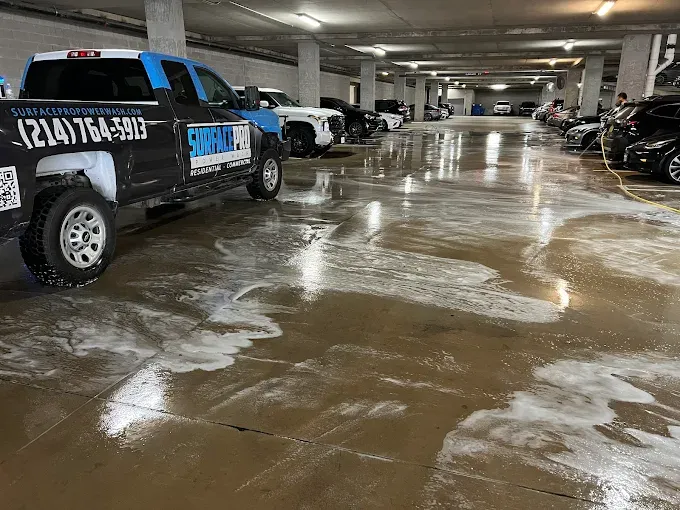
Why garages need their own approach
Surface Pro Power Wash is an exterior cleaning company based in Plano, TX, and parking structures are one of the most demanding surfaces it cleans. A garage is not a parking lot with a roof over it. It is an occupied structure with levels, ramps, drainage that has to be respected, clearance limits that dictate what equipment can get inside, and tenants who need their parking space back the same night. Everything a vehicle sheds ends up on the deck: oil and transmission drips, brake dust, tire rubber, road salt and grit carried in during winter weather, spilled drinks near elevator lobbies, and bird droppings in open stairwells. Enclosed levels get no sun and little airflow, so what lands there stays.
The deck surface decides everything
Before any water moves, the question is what the deck is actually made of. Getting this wrong is the most expensive mistake available in a parking structure.
Coated and membrane-protected decks
Elevated decks are frequently protected by a traffic-bearing waterproof membrane, usually a urethane system laid over the structural slab. Its job is keeping water and chlorides out of the concrete and away from the reinforcing steel beneath. That membrane is a wearing surface, not armor. High pressure held against it tears, lifts, and delaminates it, and once the membrane is compromised the property is looking at recoating, which is a capital line item rather than a maintenance one. Coated decks are identified during the structure walk and cleaned at reduced pressure suited to the coating, because the point of cleaning a deck is to protect the structure, not to shorten the life of the system already protecting it.
Bare and sealed structural concrete
Uncoated decks tolerate more pressure but still reward a measured approach. Concrete is porous, so oil that has sat in a stall for years has moved into the surface and comes out with degreaser and dwell time rather than force. Sealed concrete is cleaned within the limits of the sealer so the finish stays even rather than blotchy.
Ramps, turn lanes, and stairwells
Ramps and turn lanes carry the heaviest tire and oil marks in the structure, because that is where braking and steering scrub rubber onto the deck. They need the most attention and the most care, since a ramp is also where a slick surface is least forgiving. Stairwells and elevator lobbies are a different job again: pedestrian surfaces with spills, gum, and bird droppings, cleaned with pedestrian traffic in mind rather than as an extension of the deck.
Cleaning a working structure
Surface Pro Power Wash cleans garages level by level so the structure stays open. Each level and ramp is assessed first, debris is cleared before any water is used, and the wash is directed toward the existing drains.
The phasing is what makes it workable. The structure is divided into sections, each section is barricaded and then reopened as it dries, and the sequence is published to the property in advance so tenants and residents can plan. Most garage work runs overnight or on weekends when occupancy is lowest. Vehicles left parked in a section scheduled for cleaning are worked around rather than treated as a reason to stop, and the plan for handling them is agreed with the property before the night starts, not improvised at midnight.
Access shapes the plan as much as scheduling does. Clearance heights keep full-size wash trailers out of most structures, so the rig is staged where it fits and hose runs carry water to the working level. Many garages have no hose bib above the ground floor, so the water source is confirmed during the walk rather than assumed.
Where the wash water goes
This is the question a sophisticated property manager asks first and a cheap bid never mentions. Garage wash water is not clean runoff. It carries oil, sediment, and the heavy metals that come off brakes and tires, and where it ends up is a compliance matter for the property.
Drainage in a structure is not uniform. Some garages route floor drains to the sanitary sewer, some pass through an oil and water separator that needs to actually be functioning, and some discharge straight to storm. The path is confirmed during the structure walk, and the work is sequenced around it, because oily wash water sent to a storm drain becomes the property’s problem long after the crew has left.
What cleaning protects
A clean deck is the visible result. The structural case is the reason many properties keep a schedule.
- Drainage that works. Silt and debris pack into deck drains and trench grates until water stands on the slab. Standing water on a parking deck is the beginning of most concrete problems.
- Visible striping. Stall lines and directional markings disappear under film long before the paint actually fails, and a garage that looks unmarked feels unsafe.
- Slip risk. Oil film on a ramp and organic growth on open-air levels are both genuine hazards on surfaces pedestrians cross.
- Early warning. Grime hides cracking and spalling. A clean deck lets a property see developing concrete problems while they are still repairs instead of replacements.
- Chloride exposure. Grit and residue tracked in during winter weather hold chlorides against the deck, and chlorides driven into concrete are what corrode reinforcing steel over time.
Built for how property managers buy
Garage cleaning is bought by people who answer to owners, boards, and tenants, so the work has to come with a paper trail. Scope is set in writing against the structure walk rather than assumed. Phasing and reopening times are agreed in advance so notices can go out to tenants. Before and after photos by level let a manager confirm the work without walking the structure at two in the morning. Surface Pro Power Wash is fully insured, and the documentation required for vendor onboarding is provided when the account is set up. For properties with more than one structure, cleaning is scheduled across the portfolio rather than negotiated building by building.
Parking garage cleaning across Plano and DFW
Surface Pro Power Wash cleans parking structures in Plano and across the wider Dallas-Fort Worth metro, including Frisco, McKinney, Allen, Richardson, and Dallas. Surface lots are handled with parking lot pressure washing, building faces with building exterior cleaning, and residential structures as part of multifamily and apartment cleaning. For how often a structure should be cleaned, see how often a parking garage should be pressure washed. To set up a schedule, request a free quote.