
Commercial
How Often Should You Pressure Wash a Parking Garage?
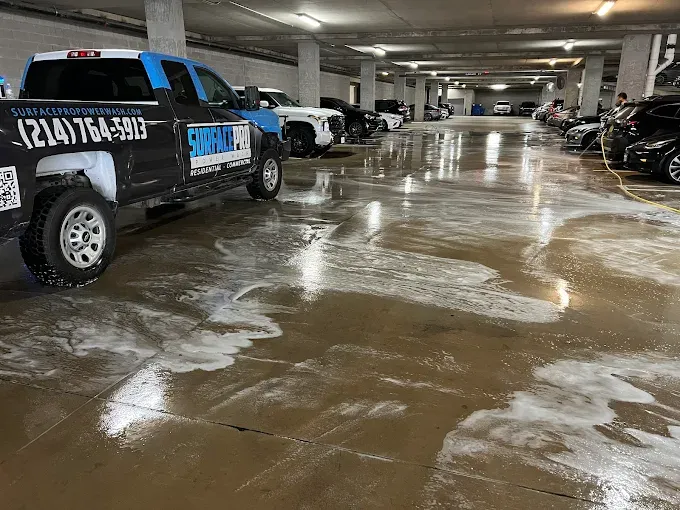
A parking garage is one of the dirtiest surfaces on any commercial property, and because it is enclosed, the buildup does not wash away in the rain the way an open lot does. So how often should it be cleaned? For most structures, once or twice a year, with high-traffic garages cleaned more often. Here is what determines the right schedule, what a proper cleaning includes, and the questions worth asking any vendor who bids on the work.
What builds up in a garage
Every vehicle leaves something behind: oil drips, black tire marks where cars brake and turn, fine dust, and tracked-in grime. Out of the sun and rain, that residue stays put and accumulates on decks and ramps. Over time it darkens the surface, makes ramps slick, and gives the whole structure a neglected look. Bird droppings collect in open stairwells, spills accumulate near elevator lobbies, and winter weather adds grit that holds moisture against the deck long after the storm has passed.
Recommended frequency by property type
Traffic is the main driver, and traffic follows the property type. As a starting point:
| Property type | Typical frequency | What drives it |
|---|---|---|
| Retail and mixed-use | Two to four times a year | Constant customer turnover, food tenants, appearance in front of shoppers |
| Class A office | Twice a year | Tenant expectations, appearance as part of the leasing pitch |
| Medical office and hospital | Two to four times a year | High turnover, around-the-clock occupancy, cleanliness standards |
| Hotel and hospitality | Twice a year or more | Valet traffic, guest impressions, porte cochere and entry levels |
| Multifamily residential | Once or twice a year | Steady but predictable resident traffic |
| Low-occupancy or overflow structures | Once a year | Slow accumulation, appearance still matters at the entries |
These are starting points rather than rules. A garage’s busiest levels can also run on a different clock than its quiet ones: many properties clean the entry level and ramps more often than the upper decks, because that is where traffic, tire marks, and first impressions concentrate.
The question most bids skip: where does the water go
Garage wash water is not clean. It picks up oil, sediment, and the metals that come off brakes and tires, and where it ends up is regulated. Some garage floor drains route to the sanitary sewer, some pass through an oil and water separator that has to actually be working, and some discharge to storm, where oily wash water is not permitted.
A professional crew confirms the drainage path before the first gallon moves and plans the work around it. This is worth asking about directly when comparing bids, because a vendor with no answer for where the water goes is leaving the compliance risk with the property. The same applies to surface lots, but it matters more in a structure, where all of the wash water funnels into a small number of drains whose destination nobody has thought about in years.
Coated decks change the job
Many elevated decks are protected by a traffic-bearing membrane, a waterproof coating system that keeps water and chlorides out of the structural concrete. That membrane is a wearing surface, not armor: high pressure held against it tears and delaminates it, and replacing a failed membrane is a capital expense rather than a cleaning line item.
A garage vendor should identify coated decks during the walk-through and clean them at reduced pressure suited to the coating. If a bid does not distinguish between coated and bare concrete, that is a sign the walk-through did not happen or did not look.
What a full garage cleaning includes
A proper scope covers more than the parking stalls:
- Decks and drive lanes, degreased where oil concentrates and surface cleaned for an even finish
- Ramps and turn lanes, which carry the heaviest tire and oil marks in the structure
- Stairwells and elevator lobbies, the pedestrian surfaces where spills and droppings collect
- Drain clearing as the wash moves, so water leaves the deck instead of standing on it
- Curbs, bumper walls, and signage faces that read as the structure’s finish level
Striping deserves its own mention. Stall lines, arrows, and accessibility markings are surface-applied paint that lifts under direct high pressure, so markings are cleaned at reduced pressure and at an angle. A garage that comes back clean but with half its striping scoured off has traded one problem for a worse one.
How cleaning happens without closing the garage
A working structure cannot shut down for maintenance, so garages are cleaned level by level. Sections are barricaded, washed toward their drains, and reopened as they dry, usually on an overnight or weekend rotation matched to when occupancy is lowest. Tenants and residents get the schedule in advance, and vehicles left in a scheduled section are handled under whatever plan the property sets, rather than becoming a reason to stop the night.
Why regular cleaning protects the structure itself
Beyond appearance, there is a structural case. Oil and grime on ramps reduce traction, which is a slip and liability risk for drivers and pedestrians. Clogged drains leave water standing on the slab, and standing water is the beginning of most concrete problems. Grit and residue hold chlorides against the deck, and chlorides driven into concrete are what corrode reinforcing steel over years. A clean deck also makes developing cracks and spalls visible while they are still repairs rather than replacements.
A documented cleaning program signals something to insurers and owners too: the property is maintained on a routine, not in reaction to complaints.
What to ask a garage cleaning vendor
- Where will the wash water go, and how will you confirm the drainage path?
- How will you identify and handle coated or membrane-protected decks?
- How is the structure phased so parking stays available, and what is the reopening time per section?
- How is striping protected during cleaning?
- What documentation comes with the work: photos by level, insurance certificate, scope in writing?
A vendor with ready answers to those five questions has cleaned structures before. A vendor without them is learning on your garage.
Setting a schedule
The simplest approach is a recurring program matched to the garage’s traffic, so cleaning happens before buildup becomes obvious rather than after a complaint. Surface Pro Power Wash provides parking garage cleaning and parking lot pressure washing on schedules built around how each property operates, across Plano and the Dallas-Fort Worth metro. To set one up, request a free quote.