
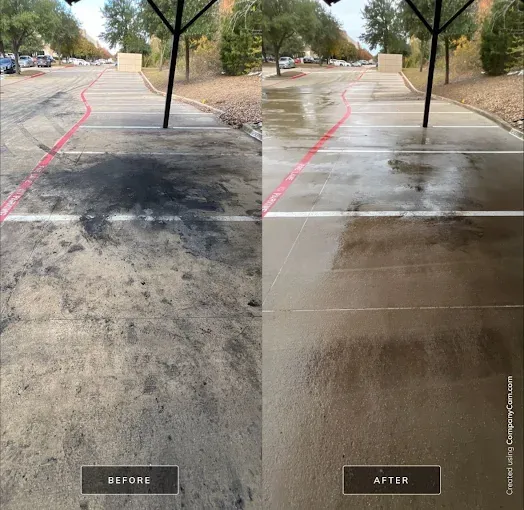
What a parking lot collects
Surface Pro Power Wash is an exterior cleaning company based in Plano, TX, and parking lot cleaning is the foundation of its commercial work. A parking lot is the first thing a customer sees and the last surface most owners think about. Across the Dallas-Fort Worth metro, lots collect tire marks, gum, spilled drinks, dirt tracked in from the road, and grease around dumpsters and tenant entrances. Texas summer heat makes it worse: pavement surface temperatures climb high enough to soften dropped gum into the surface and to draw oil deeper into asphalt, so a stain left through August is harder to lift in September. The buildup makes a center look neglected and leaves walkways slick. Scheduled parking lot pressure washing keeps the surface clean and the property presentable.
Asphalt or concrete, the surface decides the method
The single biggest factor in how a lot gets cleaned is what the lot is made of. The two surfaces look similar under a layer of grime and behave nothing alike under a pressure washer.
Asphalt
Asphalt is an aggregate held together by bitumen, a petroleum-based binder. That binder is the vulnerability. Too much pressure held in one place lifts the binder and pulls loose the stone it was holding, leaving a raveled patch that reads as damage from across the lot. Petroleum and citrus solvent degreasers do the same thing chemically, dissolving the binder they are sprayed on. Asphalt is cleaned at lower pressure with a wider fan, kept moving, and treated with alkaline degreasers that break down grease without attacking the pavement itself.
Sealcoated asphalt
A sealcoat is a sacrificial topcoat applied over asphalt, and it is thinner and softer than the pavement beneath it. Aggressive cleaning strips it unevenly, which leaves the lot looking blotchy and shortens the life of the seal the owner paid for. Sealcoated lots are cleaned gently, and where a seal is already failing it is identified during the site walk rather than discovered mid-job.
Concrete flatwork, aprons, and dumpster pads
Concrete tolerates far more than asphalt, which is why the same lot often needs two different approaches. Drive aprons, sidewalks, storefront walkways, and dumpster pads are usually concrete, and they take a surface cleaner at working pressure for an even, line-free finish. Concrete is porous, so oil that has sat on a pad for months has soaked in and needs dwell time with a degreaser rather than more force. Newer concrete near recent construction also holds mortar haze and construction film that responds to a different treatment than everyday traffic soil.
Pavement markings are paint, and paint comes off
Stall lines, directional arrows, crosswalks, ADA access aisles, and fire lane striping are surface-applied paint or thermoplastic sitting on top of the pavement. Direct high pressure lifts them. On a lot where the markings are already sun-faded, careless cleaning can take a borderline stripe to unreadable in a single pass, and fire lane markings and ADA stall markings carry compliance weight beyond appearance. Markings are cleaned at reduced pressure with the fan angled across them rather than driven straight down, and any striping that is already failing is flagged during the site walk so the owner can plan restriping rather than be surprised by it.
Gum, grease, and oil are three different problems
Treating all three as one job is why some lots come back looking only half cleaned.
Gum sits on top of the pavement and bonds mechanically. It lifts under the concentrated, rotating action of a surface cleaner, and heavy gum zones near entrances and cart corrals simply need more passes rather than more pressure.
Grease is an ongoing deposit, heaviest around dumpster pads, restaurant back doors, and grease trap access. It is treated with an alkaline degreaser given real dwell time before any cleaning, because degreaser sprayed and immediately rinsed just moves the problem across the pavement.
Oil is different again because it penetrates. A drip that has sat under a parking stall through a Texas summer has soaked into the pavement, and cleaning lifts the surface staining while the deeper shadow may remain. That distinction is set during the site walk so expectations match what the surface can actually give back.
Where the wash water goes
Wash water from a commercial parking lot is not clean rainwater. It carries oil, grease, sediment, and detergent, and once it reaches a storm inlet it goes to the same waterways rainfall does. Stormwater discharge from commercial sites is regulated, and responsibility for what enters the drain sits with the property, which is why this question comes up in serious vendor conversations and rarely in cheap bids.
Work is planned around it. Grease zones are degreased and the residue managed rather than flushed toward the nearest inlet, cleaning is sequenced so runoff is controlled, and inlets in the work area are accounted for before the first gallon of water moves. A contractor who has no answer for where the water goes is a liability the property inherits.
Cleaning a lot that cannot close
A working lot cannot shut down for the day. Surface Pro Power Wash schedules parking lot work in sections and times it around business hours, often in the evening or overnight, so customers, tenants, and deliveries are not disrupted. Overnight work on a retail site brings its own requirements: lighting, gate and access coordination, awareness of vehicles left parked overnight, and a section rotation that reopens each area as it dries. On multi-tenant properties, tenants are far more cooperative when they know the schedule in advance, so the plan is set before the crew arrives rather than negotiated in the parking lot at ten at night.
Where buildup is heaviest
- Entrances, crosswalks, and tenant doorways
- Drive lanes and stop-and-go zones
- Dumpster pads and grease tracks
- Cart corrals and bollards
- Fuel islands and canopy aprons at convenience and fuel sites
- Sidewalks and storefront aprons
A clean lot is a slip and liability question
Curb appeal is the reason most owners call. Liability is the reason many keep a schedule. Algae and organic film in shaded sections and along north-facing curb lines make a walkway genuinely slick when wet, grease tracked from a dumpster pad onto a pedestrian route is a hazard on a path customers are directed to use, and standing water over a clogged, silted drain is both. A documented cleaning schedule shows a property is maintained on a routine rather than in reaction to a complaint, which is a meaningfully different position for an owner to be in.
Built for multi-site and national accounts
More than 20 national brands, including Walmart, ExxonMobil, 7-Eleven, and Academy Sports, rely on Surface Pro Power Wash, and the same standards apply to every property, large or small. Multi-site work has its own requirements beyond the cleaning itself: each location scoped on its own terms rather than assumed identical, a rollout schedule that moves across a portfolio predictably, one point of contact instead of a different crew lead at every stop, and before and after photos so a regional manager can confirm the work without driving to the site. Surface Pro Power Wash is fully insured, and the documentation a property management company needs for vendor onboarding is provided as part of setting up the account.
Parking lot cleaning across Plano and DFW
Surface Pro Power Wash cleans parking lots in Plano and across the wider Dallas-Fort Worth metro, including Frisco, McKinney, Allen, Richardson, and Dallas. Structured parking is handled with parking garage cleaning, pedestrian paths with sidewalk and storefront cleaning, dumpster areas with dumpster pad cleaning, building faces with building exterior cleaning, and new construction handover with post-construction cleaning. For how cleaning frequency is set on a commercial property, see how often a parking garage should be pressure washed. To set up a schedule, request a free quote.