
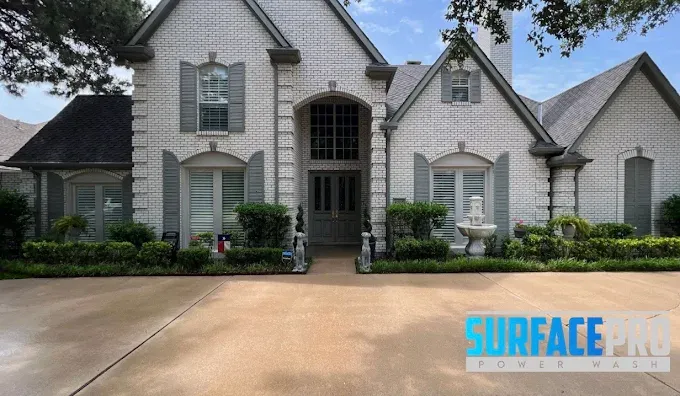
What soft wash house cleaning removes
Surface Pro Power Wash is an exterior cleaning company based in Plano, TX, and soft wash house cleaning is the core of its residential work. The Dallas-Fort Worth climate is humid subtropical: hot summers, mild wet springs, and a heavy pollen season that feeds growth on every shaded surface. Algae, mold, and mildew show up as green film on siding, black streaks under gutter lines, and a gray haze on brick, almost always starting on north- and east-facing walls that stay damp longest. Sprinkler overspray that hits the same section of wall every morning keeps one patch permanently green. Soft washing removes that organic buildup along with everyday dirt, pollen, and cobwebs, and because it treats the growth at the root, the exterior stays clean longer than it would after a surface-only rinse.
Why soft washing instead of pressure washing
Soft washing applies a cleaning solution at roughly garden hose pressure and lets the chemistry do the work. The solution is blended with a surfactant that clings to vertical walls instead of sheeting off, which gives it the wet contact time, called dwell time, it needs to break down mold, algae, and mildew where they anchor. The full comparison is covered in soft wash vs. pressure washing. High pressure works the opposite way. It shaves off the visible layer by force, and on a house that force cracks siding, strips paint, etches soft brick, and drives water behind panels where it causes hidden damage. After the wash, the solution breaks down into salt and water, and the surfactants used in professional house-wash mixes are biodegradable.
The right method for every surface on the house
Every cladding material needs its own combination of solution strength, dwell time, and rinse pressure. Matching the method to the material is the difference between an exterior cleaning company and a pressure washer pointed at everything.
Brick and painted brick
On a brick wall, the mortar joints are softer than the brick around them, so high pressure erodes the joints first, and raked-out joints let water behind the wall and require repointing to fix. Pressure can also pop the brick’s harder fired face, which starts spalling, the flaking and crumbling of the softer core underneath. Brick gets a low-pressure chemical clean and a wide fan rinse that protects both the face and the joints. Painted brick is stricter still: pressure lifts and feathers paint, forcing a repaint, so a soft wash with a mild solution is the only way to clean it without stripping it.
Stucco
Traditional stucco is a rigid, porous cement coating that normally carries hairline cracks. High pressure etches the sand-float finish, blows those cracks open, forces water behind the cladding, and leaves permanent wand marks. Stucco is soft washed at low pressure and kept wet through the full dwell, because a solution that dries on the surface stops working and can leave residue in the texture.
EIFS
EIFS, short for Exterior Insulation and Finish System and often called synthetic stucco, is a thin acrylic finish coat over mesh and foam insulation board, and the finished layer is only a few millimeters thick. A pressure washer can puncture it and drive water behind it, and trapped moisture is the most common way EIFS fails. Soft washing at garden hose pressure is the only safe way to clean it, which is why EIFS homes in particular should never be quoted a pressure wash.
Cast stone and natural stone trim
Cast stone, limestone, and similar stone accents are calcium based, so even weak acids dissolve the surface, etch the detail, and open the pores so the stone soils faster. High pressure is no better: it erodes tooling detail and drives moisture and salts deeper into the stone. The cast stone industry’s own technical guidance calls for mild detergent and a thorough rinse, and that gentlest effective method is exactly how entry surrounds, window trim, and address blocks are handled.
Vinyl, aluminum, and fiber cement siding
Vinyl siding is a drainage cladding, not a watertight barrier, so high pressure aimed up at the laps drives water behind the panels toward the sheathing. Older vinyl and aluminum also carry a chalky oxidation layer from years of Texas sun, and aggressive pressure or brushing removes that layer unevenly, leaving glossy streaks that show worst on dark colors. For fiber cement, James Hardie’s published cleaning guidance calls for a garden hose and a soft brush, and caps any pressure washing at 1,500 PSI with a wide fan tip held well back from the wall. A soft wash sits comfortably inside all of those limits.
Painted wood trim and soffits
Paint is the weather seal on exterior wood. Pressure lifts paint edges and forces water into the grain, where it swells the wood and peels the film. Trim, fascia, and soffits are cleaned with low-pressure application and rinse, and soffit vents are rinsed at an angle rather than blasted so water is never driven into the attic.
Organic stain or mineral stain, diagnosis comes first
Not every stain on a wall is algae, and the remedies are opposite, so identifying the stain comes before treating it. Green film and black streaks are organic growth and respond to the wash solution. A white or gray powder on brick, stone, or stucco is usually efflorescence, a mineral deposit left behind when water moves through masonry and evaporates at the surface, and no amount of bleach removes it because there is nothing alive to kill. Efflorescence points to a moisture source that needs attention, and it is treated mechanically and gently, not chemically. Lichens are a third case: they anchor into stone pores with root-like structures, and scraping or blasting them tears away stone with them, so they are treated and allowed to release naturally over the following weeks. Hard-water spotting from sprinkler overspray is mineral as well, which is why the inspection step matters before anything gets sprayed.
Protecting plants, pets, and everything around the house
A soft wash is planned around the landscaping, not in spite of it. Beds, grass, and root zones are pre-wetted with clean water before any solution goes on the wall, because hydrated plants absorb less. Foliage is kept wet during the application, then plants and soil are rinsed thoroughly when the wash is done, and downspouts are diverted where heavy runoff is expected. Pets and kids stay inside during the work and off treated surfaces until everything is rinsed and dry, typically an hour or two. Windows, fixtures, and outlets are checked during the walkaround, and delicate finishes near the work area are flagged before the first gallon is mixed.
Soft wash house cleaning across Plano and DFW
Surface Pro Power Wash provides soft wash house cleaning in Plano and nearby cities including Frisco, McKinney, and Allen. Driveways, walkways, and flatwork are handled separately with driveway and concrete cleaning, and outdoor living spaces with patio and deck cleaning. To get started, request a free quote.