
Cleaning Methods
Soft Wash vs. Pressure Washing: What's the Difference and Which Do You Need?
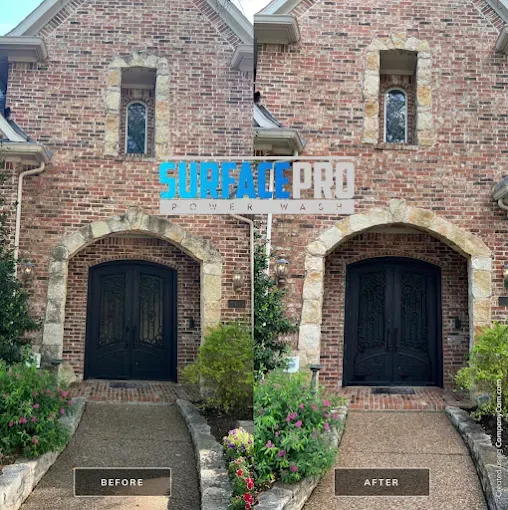
People use “pressure washing” as a catch-all term, but exterior cleaning really comes down to two methods: soft washing and pressure washing. Choosing the wrong one is how siding gets cracked and soft brick gets etched. Here is the difference, where the term “power washing” fits, and how to know which method each surface on a property needs.
The short answer
Soft washing uses low pressure and a biodegradable cleaning solution to remove algae, mold, and mildew from delicate surfaces like siding, stucco, and brick. Pressure washing uses high-pressure water to clean hard surfaces like concrete. The solution does the work in soft washing; the water pressure does the work in pressure washing.
Soft wash vs. pressure wash vs. power wash, side by side
| Soft washing | Pressure washing | Power washing | |
|---|---|---|---|
| What does the work | Cleaning solution and dwell time | Water pressure | Water pressure plus heat |
| Pressure at the surface | Roughly garden hose strength | High | High |
| Water temperature | Ambient | Ambient | Heated |
| Best for | Siding, stucco, brick, and painted surfaces | Concrete driveways, sidewalks, patios, parking lots | Grease and oil on hard surfaces such as commercial concrete |
| How long results last | Longer on organic growth, because it is killed at the root | Until growth re-anchors, on surfaces where growth is the problem | Same as pressure washing |
| Damage risk if misused | Low | High on soft surfaces | High on soft surfaces, plus heat effects |
Is “power washing” a third method?
Mostly it is a naming question. In everyday speech, power washing and pressure washing mean the same thing, and companies use the words interchangeably, including this one. In the strict sense, power washing is pressure washing with heated water. Heat is one way to attack grease and gum on commercial concrete; the same jobs are also handled with alkaline degreasers given dwell time before cleaning, which is how dumpster pads and drive lanes are treated without relying on heat. On a house, neither heat nor force belongs: residential exteriors are soft washed, where the chemistry does the work safely.
What soft washing is
Soft washing applies a cleaning solution that breaks down algae, mold, and mildew at the root, then rinses it away at a pressure no stronger than a garden hose. The solution is blended with a surfactant that clings to vertical surfaces instead of sheeting off, which gives it the contact time it needs to work. Because the chemistry does the cleaning, there is no force to crack siding, strip paint, or drive water behind panels. It also lasts longer, since the growth is killed rather than just blasted off the surface. After the wash, the solution breaks down into salt and water, and the surfactants used in professional house-wash mixes are biodegradable.
What pressure washing is
Pressure washing relies on a strong stream of water to lift dirt, grime, and stains. On the right surface it is fast and effective. On the wrong surface it etches brick, splinters wood, gouges soft stone, and forces water where it does not belong. Professional pressure washing of flat concrete is usually done with a surface cleaner, a rotating tool that cleans in wide, even passes, instead of a handheld wand that leaves visible stripes.
Which method each surface needs
- Siding, stucco, and brick walls: soft wash
- Painted wood, trim, and soffits: soft wash
- Wood and composite decks: soft wash
- Cast stone and limestone accents: soft wash with stone-safe chemistry
- Concrete driveways, walkways, and patios: pressure wash, usually with a surface cleaner
- Parking lots and other flat hard surfaces: pressure wash
- Grease zones on commercial concrete: degrease first, then pressure wash
The rule of thumb: if the surface can be damaged by force, soft wash it. If it is hard, flat, and durable, pressure washing is fine.
Can you soft wash a house yourself?
The concept is simple, but the execution is where do-it-yourself attempts fall short. Consumer pressure washers cannot draw and apply solution at the dilution professional systems use, so the mix ends up too weak to kill growth or too strong for the landscaping around it. Reaching a second story means ladder work on wet surfaces, which is where the real danger of a house wash lives. And knowing what each material tolerates, from EIFS that punctures under pressure to cast stone that etches under the wrong chemistry, is exactly the judgment that separates cleaning from damage. A professional soft wash costs less than repairing one mistake on a gable.
Why it matters in DFW
The Dallas-Fort Worth climate, with its heat, humidity, and spring pollen, grows algae and mildew fast, especially on shaded and north-facing walls. Those are exactly the surfaces that need soft washing, not high pressure. Reaching for a pressure washer on siding or stucco is the most common way homeowners damage their own home. The pattern is predictable enough that you can walk a DFW street and spot it: green film on the north face, streaks under the gutter line, and a permanently damp patch where the sprinklers hit the wall every morning.
Which do you need?
Most homes need both, used in the right places. Soft wash house cleaning handles the walls, while driveway and concrete cleaning and pool deck cleaning handle the flatwork. The simplest way to get it right is to have one team assess the property and match the method to each surface. To get started, request a free quote.