
Home Care
Is Pressure Washing Safe for My Home's Exterior? A Plano Homeowner's Guide
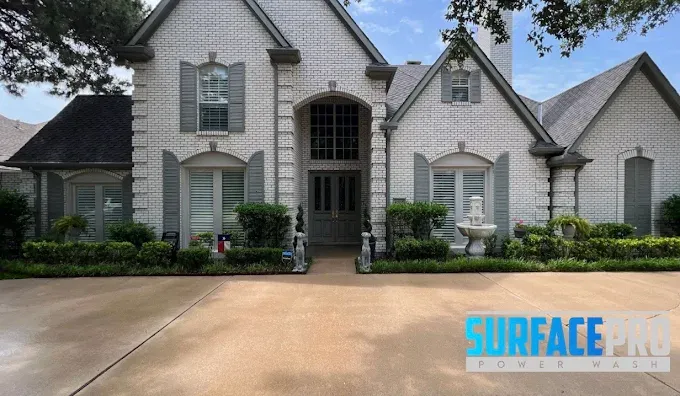
Pressure washing looks satisfying, and on the right surface it is exactly the right tool. The problem is that homeowners often point a pressure washer at the parts of a home that cannot take it. For most of a home’s exterior, the safe answer is soft washing, not high pressure. Here is where each method belongs, what damage actually looks like, and how to protect everything around the house while it is cleaned.
The quick reference: what each surface can take
| Surface | Safe approach | What goes wrong with high pressure |
|---|---|---|
| Vinyl siding | Soft wash | Cracks panels, forces water behind laps toward the sheathing |
| Older vinyl and aluminum | Soft wash | Strips the chalky weathered layer unevenly, leaving glossy streaks |
| Fiber cement siding | Soft wash within manufacturer limits | Manufacturer guidance caps pressure; exceeding it risks surface and warranty |
| Brick and mortar | Soft wash | Erodes mortar joints first, can spall the brick face |
| Painted brick | Soft wash only | Lifts and feathers paint, forcing a repaint |
| Stucco | Soft wash | Etches the finish, opens hairline cracks, leaves wand marks |
| EIFS (synthetic stucco) | Soft wash only | Can puncture the thin finish coat and trap water behind it |
| Cast stone and limestone | Soft wash, stone-safe chemistry | Pressure erodes detail; acids etch the stone permanently |
| Painted wood, trim, soffits | Soft wash | Strips paint, splinters grain, drives water into the attic at vents |
| Wood and composite decking | Soft wash | Furring on wood; permanent marks on composite |
| Concrete driveways and walks | Pressure wash with a surface cleaner | Little risk on sound concrete; wand stripes if done freehand |
| Pool decks | Depends on the surface | Coatings chip and lift; aggregate pops loose under a close tip |
The pattern is simple: almost everything vertical on a home wants chemistry at low pressure, and the flatwork underfoot is where working pressure belongs.
Where high pressure does damage
A pressure washer puts out enough force to do real harm to the wrong surface:
- Siding: it can crack vinyl, dent aluminum, and force water behind panels
- Brick and mortar: it etches the brick face and blows out aging mortar joints
- Paint and wood: it strips paint and splinters wood trim and decking
- Windows and seals: it can break seals and force water inside
The worst part is that much of this damage does not show up on the day. Water driven behind cladding becomes a moisture problem weeks later, and a mortar joint opened by pressure lets water into the wall every rain after.
Signs a home was damaged by a previous wash
If a home was cleaned cheaply and something has seemed off since, these are the classic symptoms:
- Fuzzy, raised grain on wood decking or fence pickets, where pressure tore the soft fibers
- Glossy stripes on older siding, where the oxidized layer was stripped in wand-width passes
- Paint edges lifting, feathering, or flaking where the film was forced up
- Sand or mortar dust collecting below brick walls, and joints that look raked out
- Water staining on interior walls or ceilings after exterior washing
None of these fix themselves. They are worth documenting before hiring anyone else, and they are the reason the cheapest bid on a house wash is usually the most expensive one.
What soft washing does instead
Soft washing cleans those same surfaces with a biodegradable solution and low pressure. The solution removes the algae, mold, and mildew at the root, and a gentle rinse carries it away without the force that causes damage. It is the method that protects siding, stucco, brick, and painted trim while still getting them fully clean.
Is the process safe for plants, pets, and everything else?
A professional wash is planned around what surrounds the house, not just the walls:
- Landscaping is pre-wetted with clean water before any solution is applied, kept wet during the wash, and rinsed thoroughly after, because hydrated plants absorb less
- Pets and kids stay inside during the work and off treated surfaces until everything is rinsed and dry, typically an hour or two
- Outlets, fixtures, vents, and the electrical meter are checked and worked around, and soffit vents are rinsed at an angle so water is never driven into the attic
- Windows are rinsed rather than blasted, protecting the seals that keep moisture out
Ask any contractor how they protect landscaping and what their dry-time guidance is. A crew that has real answers has done this carefully before.
What is safe to pressure wash
High pressure is the right tool for hard, flat, durable surfaces:
- Concrete driveways, walkways, and patios
- Sidewalks and entryways
- Flat hardscape in good condition
Even here, a flat-surface cleaner is used on large areas for an even finish instead of the striping a handheld wand leaves behind. Pool decks are the exception that proves the rule: coated and stone surrounds need the soft approach, which is why they are assessed surface by surface rather than assumed.
Why this matters in Plano and DFW
The North Texas climate grows algae and mildew quickly on shaded, north-facing walls. Those surfaces need regular cleaning, but they are also the most likely to be damaged by force. Reaching for a pressure washer on siding or stucco is the most common way Plano homeowners accidentally damage their own home. Add the region’s older housing stock east of US 75 and in central Dallas, where mortar is softer and paint layers are original, and the case for chemistry over force gets stronger with every decade of a home’s age.
The safe approach
Have one team assess the home and match the method to each surface: soft wash house cleaning for the walls, patio and deck cleaning for outdoor living areas, and driveway and concrete cleaning for the flatwork. For the fuller comparison of the two methods, see soft wash vs. pressure washing. To get started, request a free quote or call (214) 764-5913.